
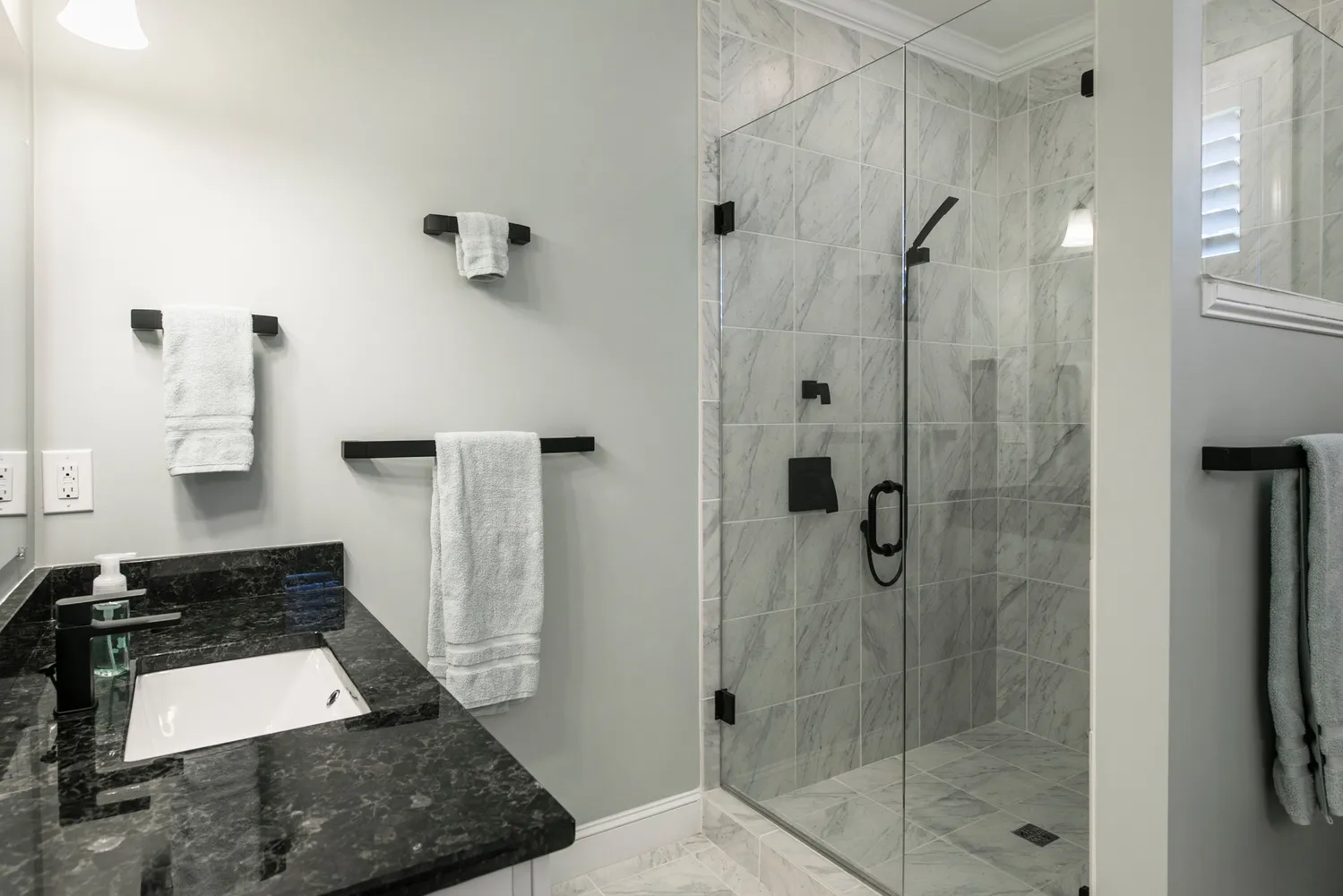
A frameless shower panel can weigh well over 100 pounds, stand taller than you, and get bumped, leaned on and splashed with hot and cold water every day. Yet it is made of the same basic material as a drinking glass. So why doesn’t it crack? The answer is a clever bit of engineering called tempering, and once you know how it works, you will never look at your bathroom the same way.
Strength by squeezing
Ordinary glass, called annealed glass, is cooled slowly so it has almost no internal stress. That makes it easy to cut, but also easy to break. Tiny scratches on the surface act as starting points for cracks.
Tempered glass is made differently. A finished, already-cut panel is heated to roughly 1,150°F, just below the point where it would start to soften. Then powerful jets of cold air blast both sides at once. The outer surfaces cool and harden instantly, while the core is still hot.
As the core cools later, it tries to shrink. But the rigid surfaces are already locked in place, so the core pulls them inward. The result is a panel with its outer skin under constant compression and its center under tension. To break it, a force first has to overcome that built-in squeeze. That is why tempered glass is about four times stronger than annealed glass of the same thickness.
If you are browsing glass shower doors near me Arlington Heights, every panel you see on a quality enclosure has been through this process. In the United States, federal safety rules require safety glazing in shower and bathtub enclosures.
A 400-year-old party trick explains it
Scientists have known about this effect for centuries thanks to Prince Rupert’s drops. These are tadpole-shaped beads made by dripping molten glass into cold water. You can hit the round head with a hammer and it will not break. But snip the thin tail, and the entire drop explodes into powder.
The drop works exactly like tempered glass: a compressed skin protecting a tense core. The head survives the hammer because the compression resists the blow. The tail is the weak point, where the stress balance is easiest to disturb. Your shower door is a flat, controlled version of the same idea.
Why it breaks into pebbles
That stored energy explains the other famous property of tempered glass. When it does fail, the tension in the core releases all at once and races across the whole panel. Instead of splitting into long, sharp shards, the glass shatters into thousands of small, blunt, cube-like pieces.
That is the whole point of safety glass. The small fragments are far less likely to cause serious cuts. It is also why homeowners researching glass shower doors near me Mount Prospect should never accept plain annealed glass for a shower, no matter how it is framed.
You cannot cut it afterward
Here is a surprising consequence. Once glass is tempered, it cannot be cut, drilled or notched. Any attempt breaks the compressed surface and the panel shatters. That is why every hole for a hinge, every notch for a clamp and every cutout for a handle is made before the glass goes into the tempering oven.
It also explains why custom enclosures are measured so carefully. The glass is essentially finished the moment it leaves the furnace. There is no trimming a quarter inch on site.
How to spot tempered glass at home
Curious whether a panel in your home is tempered? Try these checks:
- Look for the bug. Most tempered panels carry a small etched mark in one corner showing the manufacturer and safety standard.
- Wear polarized sunglasses. Look at the glass at an angle in daylight. You may see faint dark stripes or spots. These are quench marks, left by the air jets during tempering.
- Check the edges. Tempered panels usually have smooth, polished edges, because edges must be finished before tempering.
If you are comparing options for glass shower doors near me Schaumburg, try the sunglasses test on a showroom panel. It is a fun way to see the invisible stress pattern that keeps the glass strong.
The one weak spot: the edge
Tempered glass is strongest on its flat faces and most vulnerable at its edges. A sharp knock on an exposed edge, from a tile, a stone countertop or a dropped fixture, can disturb the stress balance just like snipping the tail of a Prince Rupert’s drop. That is why well-designed hardware protects edges, and why installers keep glass from touching tile or stone directly.
Very rarely, a microscopic impurity called a nickel sulfide inclusion can cause a panel to break on its own, sometimes years later. Some manufacturers reduce this risk with a heat-soak test, which deliberately stresses panels to weed out flawed ones before they leave the factory.
The takeaway
Your shower glass is not strong because it is thick. It is strong because it is squeezed. A few seconds of intense heat and a blast of cold air turn fragile glass into a panel that can take daily knocks, temperature swings and years of use. And if it ever does fail, it does so in the safest way glass can.